The same limestone bedrock that gives Lancaster County its rich soil keeps basements chronically damp. Here is how the right dehumidification protects your air, your home, and your HVAC.
Key takeaways
- Much of Lancaster County sits on limestone karst, which keeps basements chronically damp.
- The EPA recommends indoor humidity below 60%, ideally 30-50%, to limit mold and dust mites.
- A standard AC alone often cannot keep a karst basement dry — dedicated dehumidification does.
- Fixing condensate drainage and moisture sources matters as much as the equipment you add.
- We diagnose the moisture source and right-size indoor air quality solutions.
There is a reason Lancaster County grows some of the best crops in the country, and it is the same reason so many basements here feel like a cave in July. Under the fields and under the town sits limestone karst, a bedrock riddled with fractures and dissolved channels that move groundwater in ways sandy soil never would. That geology gives us fertile farmland and, less happily, sinkholes and chronically damp basements across the county.
If your Mount Joy basement smells musty, if the concrete sweats, if boxes get clammy and the dehumidifier you bought at the hardware store fills its bucket every day and still loses the fight, the ground under your house is the reason. The good news is that this is a solvable problem, and solving it protects far more than a storage room.
Why karst basements stay wet
In karst terrain, groundwater does not stay put. It travels through fractures and seams in the limestone, and it finds foundations. Combine that with our humid summers, when outdoor dew points climb high, and a basement becomes a moisture trap: cool masonry walls, warm humid air, and condensation forming on every surface below the dew point. The water is coming from both directions, up through the slab and walls, and in through the air.
The number to aim for
The EPA recommends keeping indoor relative humidity below 60 percent, with an ideal range of 30 to 50 percent, to control mold and dust mites. Many Lancaster County basements sit at 65 to 80 percent all summer without help. Getting under 50 changes everything about how the space feels and smells.
What chronic dampness actually costs you
A damp basement is not just unpleasant. It has consequences that reach through the whole house:
- Mold and mildew growth on walls, framing, stored belongings, and inside HVAC equipment
- Musty odors that rise into living spaces through the stack effect as warm air moves upward
- Dust mites and allergens that thrive above 50 percent humidity, worsening asthma and allergies
- Rust and corrosion on the furnace, water heater, and ductwork sitting in that moist air
- Wood rot in joists and sill plates, and buckling of any finished flooring
- Higher cooling bills, because humid air feels warmer and the AC works harder
That last point surprises people. Humidity and comfort are linked: a house at 78 degrees and 45 percent humidity feels better than the same house at 74 degrees and 65 percent. Controlling moisture can let you raise the thermostat a couple of degrees and still feel cooler, which is part of why dehumidification is an indoor air quality and an efficiency measure at once.
Why the portable unit is losing
The store-bought portable dehumidifier is not useless, but it is outmatched by a karst basement. It has limited capacity, you have to empty the bucket constantly or babysit a drain hose, it struggles in cooler basement temperatures, and it only treats the air in one room. Against groundwater moving through limestone, it is a bucket against a tide.
The whole-home approach
A properly sized whole-home or basement dehumidifier is a different class of machine. It moves far more air, drains automatically to a sump or condensate pump so there is no bucket, runs efficiently at basement temperatures, and can be set to a target humidity and left to hold it. Integrated with your HVAC, it can condition the whole house's air, not just one room.
| Factor | Portable unit | Whole-home unit |
|---|---|---|
| Capacity | Limited, fills bucket fast | High, matched to the space |
| Drainage | Manual bucket or short hose | Automatic to sump or pump |
| Coverage | One room | Whole basement or home |
| Control | Manual dial | Set-and-hold humidistat |
| Cold-basement performance | Poor | Designed for it |
Moisture control is a system, not one gadget
The best results come from layering: grade soil away from the foundation, fix gutters and downspouts, run a good sump with battery backup, seal obvious cracks, then dehumidify the air that remains. Dehumidification handles what you cannot keep out; keeping bulk water out first makes it far more effective.
Protecting the equipment down there too
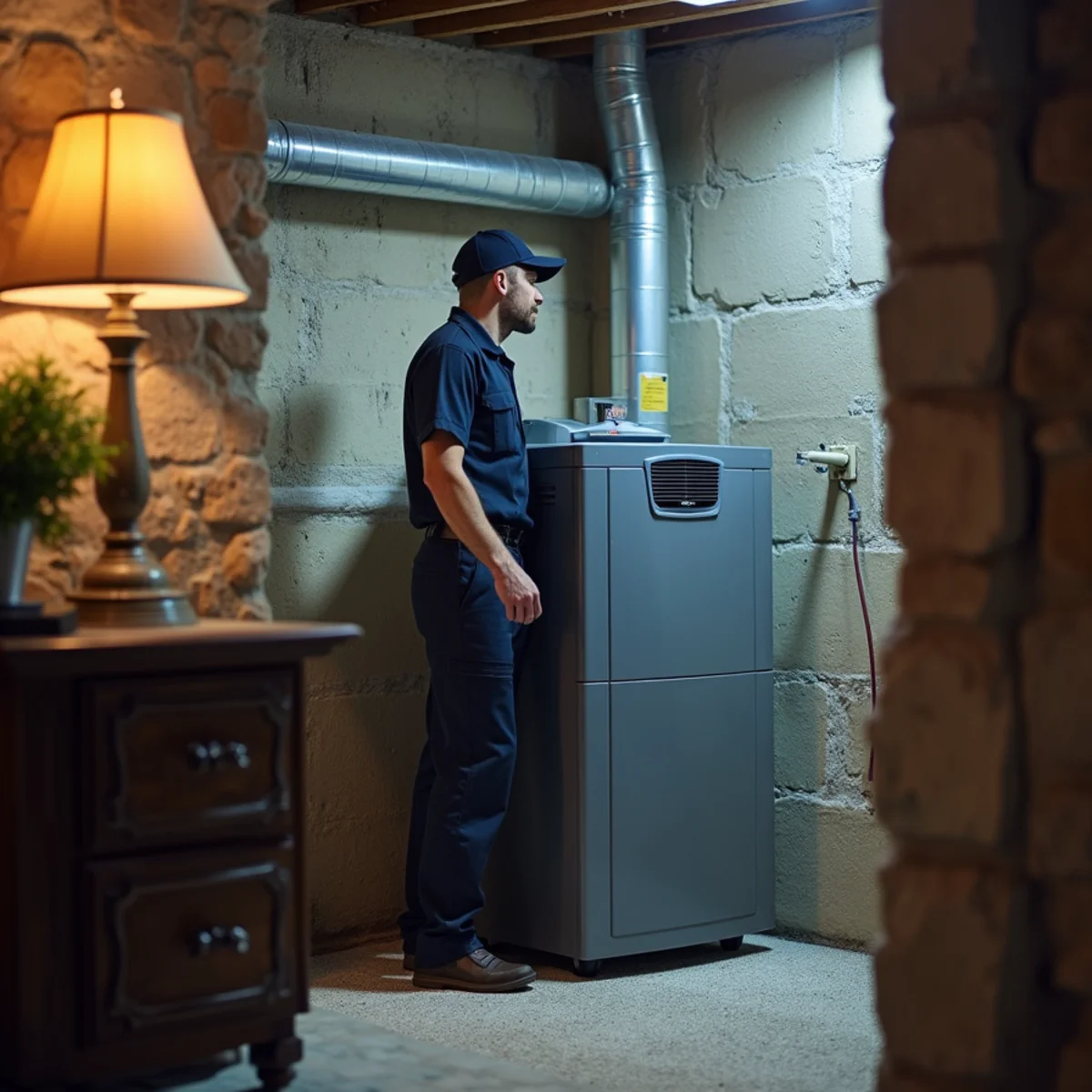
Most Mount Joy homes keep the furnace, water heater, and ductwork in the basement, which means that damp air is corroding the very system that heats and cools the home. Controlling basement humidity extends the life of that equipment and keeps mold out of the ducts that distribute air upstairs. If your ducts have been sitting in a humid basement for years, they are worth inspecting; damp duct interiors are a common hidden source of household allergens, which ties directly into our ductwork services.
A dry basement is a healthier home
You cannot change the limestone under Lancaster County, but you can control what the geology does to your air. A right-sized dehumidification setup, integrated with the moisture management your specific home needs, turns a clammy, musty basement into dry, usable space and takes a real load off your HVAC and your lungs. Homes throughout Lancaster County live with this exact problem, and it responds well to a proper fix.
If your basement is fighting the karst and losing, call HVAC Mount Joy PA at +1 (327) 210-5999. We will measure the moisture, size the solution to your home, and get your humidity into the healthy range.
Humidity control across the county
HVAC Mount Joy PA designs and installs whole-home dehumidification and air-quality systems in Mount Joy and throughout Lancaster County, sized for our karst basements and humid summers. Licensed, insured, and here year-round.
Measure before you buy
Pick up an inexpensive hygrometer and track your basement humidity for a week before buying equipment. If it sits above 60%, a whole-home dehumidifier tied into your system usually solves it — and we can size it to the actual load.
Related HVAC help in Mount Joy
Services: Indoor Air Quality Solutions · Ductwork Repair & Installation · HVAC Maintenance & Tune-Ups
Service areas: HVAC in Lancaster County · HVAC in Mount Joy Township
Frequently asked questions
Much of the county sits on limestone karst, a fractured bedrock that channels groundwater toward foundations. Combined with humid summers and cool basement walls that cause condensation, this keeps basements chronically damp, often at 65 to 80 percent relative humidity without active dehumidification.
The EPA recommends keeping indoor relative humidity below 60 percent, with an ideal range of 30 to 50 percent. That range controls mold, dust mites, and musty odors. Many local basements need a properly sized dehumidifier to hold under 50 percent through the summer.
For a karst basement, usually yes. A whole-home unit has far greater capacity, drains automatically so there is no bucket to empty, performs well at basement temperatures, and holds a set humidity level across the whole space. Portable units are quickly overwhelmed by groundwater-driven moisture.
Yes. Warm air rises through the home in what is called the stack effect, carrying musty odors, mold spores, and allergens from a damp basement into living spaces. Controlling basement moisture improves air quality throughout the house and protects HVAC equipment stored down there.
HVAC Mount Joy PA
Licensed, insured HVAC contractor serving Mount Joy and Lancaster County with same-day and 24/7 emergency service. Have a question about your system? We’re glad to help.