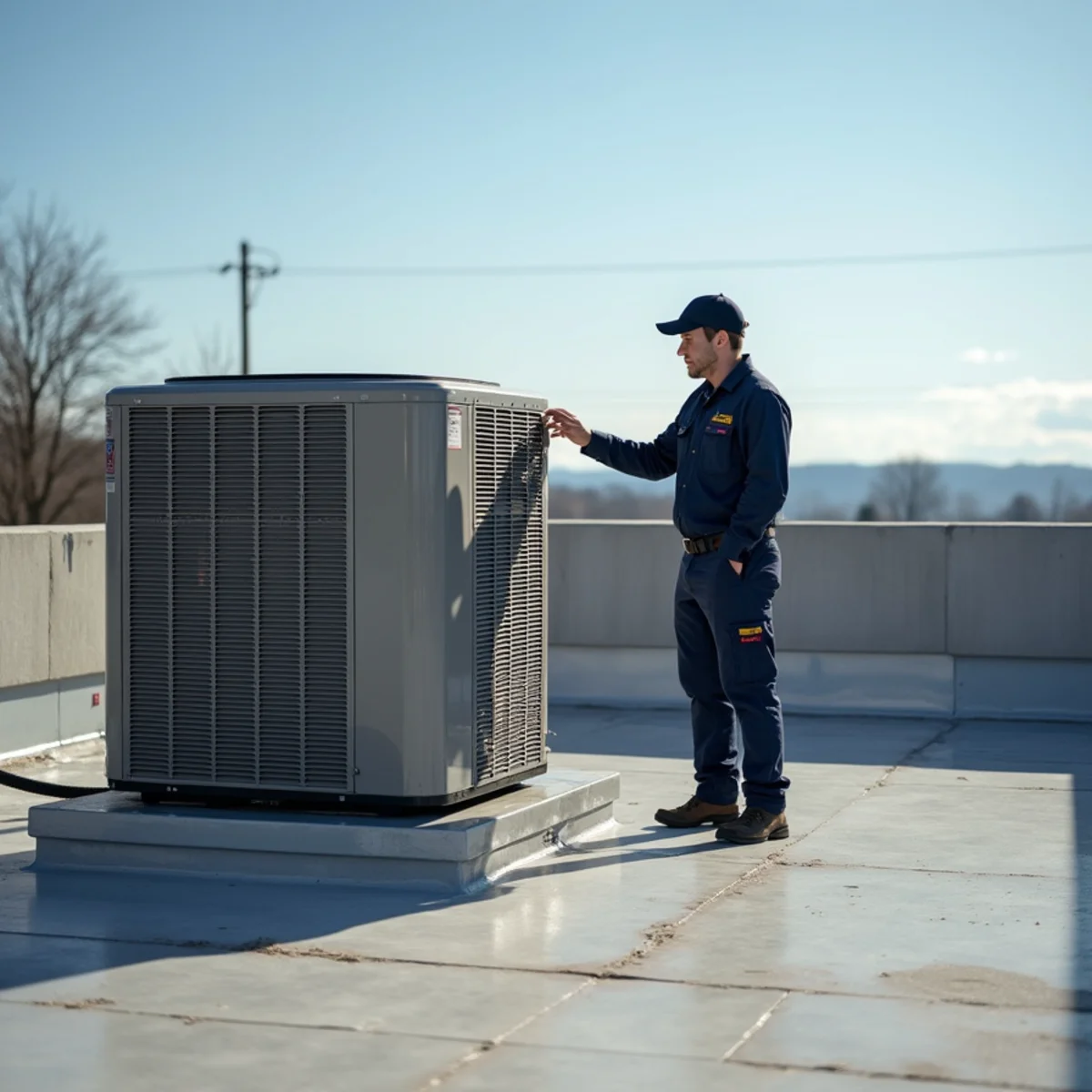
A rooftop unit on its last legs forces a hard question: sink another repair into it or replace it. Get the decision wrong and you either waste capital or gamble your summer uptime.
Key takeaways
- A rooftop unit past 15 years facing a major repair is usually a replacement candidate.
- Repeated compressor or coil failures and rising energy costs tip the math toward replacing.
- Newer units run more efficiently and are easier to keep in parts than aging ones.
- Phased, budgeted replacement beats reacting to a peak-season failure.
- We assess condition and plan capital replacement through our commercial HVAC service.
Every business owner with a rooftop unit eventually faces the same crossroads. The RTU that has cooled your strip-center suite or light-industrial building for fifteen summers is limping, and the technician hands you a repair quote that makes you wince. Do you pay it, or is it throwing good money after bad? Guess wrong and you either waste capital on a unit that dies next July, or scrap a machine that had years left.
This is a numbers decision, not an emotional one. Here is the framework we use with businesses across Lancaster County to make the call with confidence.
Start with the four numbers that matter
Before you weigh any repair quote, gather four facts about the unit. Together they tell you almost everything.
- Age of the unit, most commercial RTUs last 15 to 20 years with maintenance
- Cost of the proposed repair versus the cost of a new unit
- Repair history over the last two years, a pattern of failures is a warning
- Energy cost trend, a unit that keeps getting more expensive to run is telling you something
The 50-percent guideline
A common rule of thumb: if a single repair costs more than half the price of a comparable new unit, and the equipment is past two-thirds of its expected life, replacement is usually the better investment. Below that threshold on a younger unit, repair almost always wins.
The refrigerant factor changes the math
Older rooftop units may still run on refrigerants that are being phased down under EPA rules. The transition away from higher-GWP refrigerants like R-410A toward lower-GWP alternatives, which took effect for new equipment starting January 1, 2025, means the cost and availability of servicing older systems will keep rising. If your unit needs a major refrigerant-related repair and uses an older refrigerant, that pushes the decision toward replacement, because you may be pouring money into a system whose service costs only climb from here.
Compressor and coil failures are the tipping point
A failed compressor or a leaking evaporator coil on an old unit is often the moment to replace. These are the most expensive components, and on aging equipment, replacing one frequently precedes the failure of another. When the technician says compressor, get a replacement quote before you authorize the repair.
Repair-versus-replace at a glance
| Factor | Lean toward repair | Lean toward replace |
|---|---|---|
| Unit age | Under 10 years | Over 15 years |
| Repair cost | Under 30 percent of new | Over 50 percent of new |
| Recent breakdowns | First real problem | Third call in two years |
| Refrigerant type | Current-generation | Older phased-down refrigerant |
| Energy bills | Stable | Climbing year over year |
| Major component | Capacitor, contactor, motor | Compressor or coil |
Do not ignore the efficiency dividend
A fifteen-year-old rooftop unit was never as efficient as today equipment, and years of wear have made it worse. A modern high-efficiency RTU with an economizer that pulls in free cooling on Lancaster County mild spring and fall days can cut cooling energy use substantially. For a building that runs its units hard through our humid July peak, those savings are real money that offsets part of the replacement cost every year. When you compare quotes, ask the installer to estimate the annual energy difference, not just the sticker price.
Factor in downtime and uptime risk
Numbers on a spreadsheet miss one thing: the cost of the unit failing at the worst possible moment. An old RTU that has already broken down twice is likely to break down again during a heat wave, exactly when a replacement will be hardest to schedule and your business least able to close. If your operation cannot tolerate a multi-day outage, that risk alone can justify planned replacement now over a gamble on another repair.
Replace on your schedule, not the weather
The smartest owners replace failing units as planned capital projects, in the shoulder seasons, with time to compare quotes and size the equipment correctly. Proper sizing matters: a replacement designed with ACCA Manual J and S calculations, rather than a lazy like-for-like swap, delivers better comfort and lower bills for its entire life. Our commercial HVAC team handles quality installation and capital planning for businesses from Mount Joy to East Hempfield Township, and our maintenance plans keep new units performing so the cycle does not repeat early.
If you keep maintenance current, you also get an honest read on remaining life. Our guide to commercial HVAC maintenance explains how documented service history turns the repair-or-replace question from a guess into a decision.
Facing a big rooftop repair quote? Call HVAC Mount Joy PA at +1 (327) 210-5999 for a straight assessment and a side-by-side repair-versus-replacement estimate before you commit.
Get both numbers
We give business owners a clear repair quote and a replacement quote side by side, with the energy and downtime math laid out, so you can make the call on facts. Serving strip-center and light-industrial buildings across Lancaster County.
Plan replacement off-season
The worst time to replace a rooftop unit is the day it dies in a heat wave — you pay a premium and lose business. Track age and condition so you can schedule the swap in a shoulder season on your terms.
Related HVAC help in Mount Joy
Services: Commercial HVAC Services · AC Installation & Replacement
Service areas: HVAC in East Hempfield Township · HVAC in Lancaster County
Frequently asked questions
With regular maintenance, most packaged rooftop units last 15 to 20 years. Units that skip service, or that run hard through humid summers without coil cleaning, often fail closer to 10 to 12 years. Documented maintenance is the single biggest factor in longevity.
Sometimes. If an old unit still runs reliably, efficiency alone rarely justifies replacement. But when it is already failing, the energy savings from a modern high-efficiency RTU with an economizer become a meaningful part of the payback and can tip a close decision toward replacing.
Not immediately. Existing systems can keep running and being serviced. But as older refrigerants are phased down, servicing them gets more expensive and less certain, so a major refrigerant-related repair on an old unit is a strong signal to replace rather than repair.
Yes, and for multi-unit buildings that is often the smart capital-planning approach. Replacing the worst-performing units first spreads cost over several budget years while cutting your biggest downtime risks. We can help you sequence a phased replacement plan.
HVAC Mount Joy PA
Licensed, insured HVAC contractor serving Mount Joy and Lancaster County with same-day and 24/7 emergency service. Have a question about your system? We’re glad to help.